
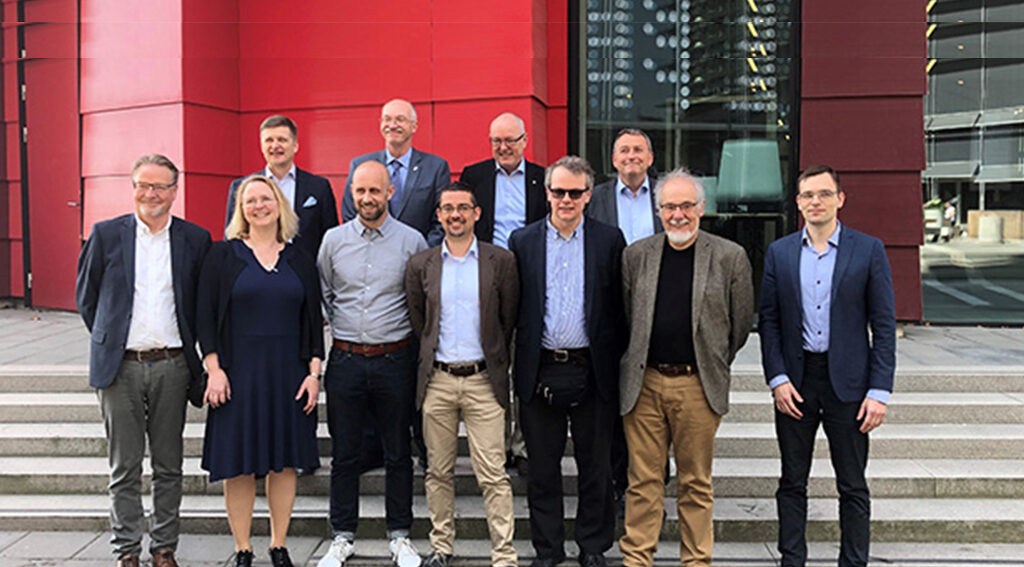
Paytend Technology, a Chinese company developing and selling financial services software, has announced choosing Vilnius, Lithuania, for its European headquarters. The company plans to hire up to 50 highly qualified professionals in the fields of sales marketing, compliance, product development and customer support in the following 3 years. One of the main reasons why the company, which will operate in Lithuania via subsidiary Paytend Europe, chose Lithuania was the country’s favourable and flexible regulatory environment. “Obtaining an electronic money institution license from the Bank of Lithuania was a straightforward, transparent and efficient process,” Junqing Li, CEO of Paytend Europe, say.…
Author: Fintechnews Baltic
The Astana Financial Services Authority (“AFSA”) has established a cooperation with Bank of Lithuania. The Agreement provides a framework for co-operation, information sharing and referrals in fintech innovations area between the AFSA and Bank of Lithuania. Parties believe that through co-operation with each other, they will be able to further the promotion of innovation in their respective markets. In this light, the framework also anticipates potential development of joint innovation projects on the application of key technologies such as digital and mobile payments, blockchain and distributed ledgers, big data, flexible platforms (API), and other areas of new technologies and services,…
Last week, Lithuania held the largest financial technologies (fintech) conference in the Baltic States – the Fintech Inn conference – with more than 1.300 attendees. With the help of world-class experts (both home-grown and international), the country seeks to increase the speed of fintech innovation adoption. Vilius Šapoka, Minister of Finance of Lithuania, claimed that Lithuania is one of the most attractive countries for fintech startups and research and development (R&D) around fintech. “In such a short period of time Lithuania became the fastest growing fintech hub and it is not going to stop. I don‘t know a country where…
For the vast majority of people, public relations, marketing, and communication may be perceived as one single project; hence, it may be hard to differentiate from one another. Nevertheless, a debrief with active professionals in this sphere will make you quickly realize that each single term is are utterly different and so are these activities. Fintech News Networks had the pleasure to assist a conference in Lithuania during the Rise Vilnius Fintech week and eagerly listened to a speech conducted by Julija Jegorova and Yana Lapitskaya, both of them having founded their own Public Relations and Marketing agencies Black Unicorn PR…
“We are on the right path to finally make a spurt with the Lithuanian Skype. If startups get the support of banks we will witness a much faster breakthrough which will result in a win-win situation for both sides“, says Danielius Stasiulis, a spokesman for the startups of financial technologies. One success story of such kind acts as a catalyst – it shakes the entire market of startups in the country and then entrepreneurs can learn from the example of good practice instead of working by trial and error method. Cooperation between banks and FinTech was also discussed last week…
For the first time in Lithuania starts “Rise Vilnius FinTech Week” which will take place from 22 to 26 October 2018 in Vilnius. Everyone interested in FinTech industry will have the opportunity to hear more about the development of this field in Lithuania, its future perspectives, challenges and insights on the latest achievements directly from the leaders of the financial technology sector. This week the Global FinTech community “Rise Vilnius” invites to participate in their organized events, seminars, discussions and meetings, and the networking sessions on the most relevant FinTech topics. According to Mariano Andrade Gonzalez, the executive director of…
In the past years, Sweden has witnessed the rapid growth of its fintech ecosystem with 188 fintech companies established in Stockholm alone as of early 2018, according to the Stockholm Fintech Guide by Invest Stockholm. Several of these ventures have risen to international fame. Klarna won a full banking license in June 2017, payments company Bambora was acquired by Ingenico for 1.5 billion EUR in July 2017, PayPal made its biggest acquisition ever by buying Swedish payments startup iZettle for US$2.2 billion, and BIMA, a Swedish insurtech startup, raised US$96.6 million in a strategic investment from Allianz X in December…
The Bank of Lithuania and the National Bank of Ukraine have agreed to work together to facilitate development of financial innovations. The Co-operation Agreement in the Area of Innovation Development between the two institutions was signed on the sidelines of Annual Meetings of the International Monetary Fund (IMF) and the World Bank Group being held in Nusa Dua, Indonesia, where Fintech issues are discussed at the highest level for the first time. “Given the avid interest from our Ukrainian counterparts and the knowledge we have acquired as part of our successful cooperation with the Monetary Authority of Singapore, we stand…
Temenos , the banking software company known for it core banking solutions has successfully upgraded Baltic International Bank’s private, corporate and retail business lines of Temenos T24 Core Banking to R17. The implementation was supported by Foranx, a certified Temenos services partner. The bank decided to upgrade in order to support its efforts to geographically expand into new markets, and continue to innovate to meet evolving customer expectations. Temenos and its partner Foranx analyzed the bank’s local developments and adapted them to the new instance of T24 Core Banking, as well as installed new modules, before finally migrating the bank to the upgraded…
The Baltic states are gaining importance on the international fintech scene partially as a result of commitment of the different governments but also because of a very active startup scene and entrepreneurial spirit. These countries are increasingly being recognized as fintech-friendly jurisdictions and as attractive places for expansion within the European Union. In recent months, a lot has happened in terms of fintech developments in the Baltic states. The followings are some of the key announcements made these past weeks: Lithuania launches fintech regulatory sandbox Startups and other businesses developing fintech solutions will soon be able to test their…
The Baltic states, formed by Lithuania, Latvia and Estonia, are looking to create an environment favorable to entrepreneurship, international talent, and fintech innovation. Estonia, the richest and most developed country among the three Baltic states, has become in recent years a true tech hub supporting the development of innovative ideas. Some fintech companies based or born in Estonia have a worldwide reach, the most notable one being Transferwise. Meanwhile, the Latvian startup ecosystem, yet still nascent, has been booming supported by the government. According to B-Hive, fintech is the most developed technological field in Latvia’s economy. Finally, Lithuania has been…
Taking advantage of the Brexit fallout, Lithunia has been seen to be aggressive in positioning itself as a fintech friendly destination in Europe. While it is not the first country that comes to mind as the next-in-line as a fintech hub in Europe, a recent report has shows that there are currently 117 fintech companies operating in the country. Indicating a relative success with its strategy. Lithunia is also not lacking when it comes to innovative startups, a recent piece done by Fintech News Switzerland highlights 10 interesting startups in Lithunia. Continuing on its ambitions, the central bank, Bank of…
The Bank of Lithuania has been selected as the winner of the first Catalyst Award in the FinTech & RegTech Global Awards 2018 organised by Central Banking. The award was given and the Bank of Lithuania’s activities in the field of innovation was presented in Singapore, one of the most important global financial centres, the Awards running in unison with the central banks’ global summit focusing on new FinTechs and supervisory challenges. According to Central Banking, a journal on the world’s central banks, the judging panel was impressed with the central bank’s broad-based approach to FinTech, and particularly with having…
The Baltic States, which comprise Estonia, Latvia and Lithuania, have recognized the prospects of fintech and are all looking to excel in digital finance. The region’s large startup community, supportive governments and favorable regulations have helped accelerate the growth of fintech. Several foreign startups have already made the leap and expanded into the region, and while there are numerous reasons why to choose Estonia, Latvia or Lithuania, over other EU countries, these are the seven main comparative advantages that the Baltic States offer: Startup hub Estonia benefited from the early success of the likes of Skype and TransferWise and…
The Baltic States, namely Estonia, Latvia and Lithuania, are an exciting place to be for financial services companies and fintech startups. The region is quickly becoming a prominent hub for fintech companies, and is home to not only successful ventures competing on the international scene, but also companies that are defining the agenda of innovation in many areas including money transfers, peer-to-peer lending, and blockchain applications. Fintech in the Baltic States Perhaps one of the most prominent fintech companies from the Baltic States is TransferWise, an Estonian developed and UK-based money transfer service launched in 2011. TransferWise is part of the…
Five years ago, Danish consumers were introduced to a new app, MobilePay. The free of charge and user-friendly solution gave smartphone owners the opportunity to make instant payments knowing just the phone number of the beneficiary. This was the start of the mobile payment revolution. Today, MobilePay has over 4 million private clients across two countries – about 3.9 million in Denmark (90% of the population) and around 0.6 million users in Finland. The app is also used by more than 90,000 businesses. It is estimated that Danish users of the app make payments worth about 137,000 Danish krones (more…
In July, Bank of Lithuania granted an electronic money institution (EMI) license to TransferGo. “We believe that this license will allow us to offer an even better product for international payments in the European Economic Area, because when you hold people’s money, you can offer them better prices. We will be able to provide bank accounts for private individuals and businesses if they need them. They will be part of our ecosystems product,” Daumantas Dvilinskas, CEO of TransferGo, told VŽ, a Lithuanian business daily. TransferGo had sent their license application to Bank of Lithuania last year. Through the company’s platform,…
The Baltic states have become a hotbed for blockchain technology with the region being named “a crypto paradise” for its high concentration of Bitcoin full nodes, strong initial coin offering (ICO) activity, and the fervent support from local governments. This year already, Lithuanian ICOs have raised US$249 million, placing the country third in the world for funds raised, while Estonian capital Tallinn stands as one of the top ten cities in the world. On the topic of blockchain technology, all three Baltic states struck an accord to support blockchain adoption notably in capital market innovations, and are also individually encouraging the development…
Corporate bond offerings were always one of the most compelling ways to invest. Usually, it is considered a big players game. But Lithuanian real estate development crowdfunding startup Röntgen is about to disrupt that stereotype. The platform successfully distributed 14-months bonds worth half a million Euros at 12 percent yield in just 12 days. REWO, a real estate development and investment management company, was the first to make the corporate bond offering on Röntgen. In total, the company has sold bonds worth 3 million Euros to help finance the new real estate project. One-sixth of all raised money came from…
The world is dealing with a widespread adoption of cryptocurrencies, and it’s not an easy ride. Bitcoin, the world’s largest digital currency, is down more than 50% this year, and 66% down from its all-time high of almost $20,000 in late December. Ethereum, Ripple, Litecoin, and other cryptocurrencies have gone through similar dramatic drops in the past months. One of the main reasons for the cryptocurrency market drop is the uncertainty brought on by new regulations issued by governments and the volatility of the market. For example, Japanese government has just ordered six cryptocurrency operators to improve their measures against…