


The Latvian startup ecosystem continued to grow over the past year, with the number of ventures, employees and tax contributions all increasing.
New data released by Startin.LV, a non-profit non-government organization representing the ecosystem, show that the ecosystem expanded by 11% in 2025, rising from 512 startups at the end of 2024 to 569 a year later. These companies now employ 5,101 individuals, representing a 7.4% increase from 2024.

The expanding ecosystem also contributed more to state revenue, paying a total of EUR 110.4 million in taxes to state budget in 2025. This represents a 25.5% increase from 2024, highlighting these innovative businesses as a significant source of fiscal income for Latvia.

In 2024, Latvian startups generated EUR 610.5 million in turnover, a 16.2 % rise from 2023, and recorded EUR 29.8 million in profit. This growth reflects the expanding scale and activity of Latvian companies.

B2B, software lead Latvia’s startup landscape
The Latvian Startup Report 2025, produced with the support of the Latvian Investment and Development Agency, the Riga Investment and Tourism Agency, and the Ministry of Economics, notes that business-to-business (B2B) ventures are the most prevalent, with 418 companies and a 73.5% share. Business-to-consumers (B2C) firms follow with 217 companies, or a 38.1% share, and business-to-government (B2G) enterprises with 66 companies and a 11.6% share.
Most of Latvian startups provide software solutions (60.3%), followed by hardware (25.5%), and a combination of hardware of software (14.2%). Unsurprisingly, the majority of Latvian tech startups are based in the capital city of Riga (81.2%), though about 6% are from each of the Vidzeme and Kurzeme regions.

Looking at funding trends, the report shows that investment rebounded in 2025, surging 127% year-over-year (YoY) to EUR 78 million. However, this level remains below the 2021 peak of EUR 259.4 million, and below the 2022 level of EUR 84.8 million.

Deeptech surges
Deeptech is highlighted in the report as a fast-growing tech category in the Latvian startup ecosystem, comprising 150 startups or 26% of the ecosystem. In 2024, these companies achieved a turnover of EUR 149 million (+6% YoY), and paid EUR 35.4 million in taxes (+84% YoY). In 2025, they employed 1,538 people in 2025, representing a 29% YoY increase and further underscoring the vertical’s rapid expansion.
In 2025, the three largest investments in Latvia went towards deeptech companies, reflecting strong investor confidence in the sector’s long-term potential. These investments were Aerones’ EUR 54.1 million round, Trace.Space’s EUR 4 million seed funding, and Handwave’s EUR 3.7 million round.
Aerones is a robot-enabled wind turbine maintenance and inspections service provider; Trace.Space provides a platform to assist engineers in creating industrial products; and Handwave is a biometric identification startup.

Fintech remains prominent
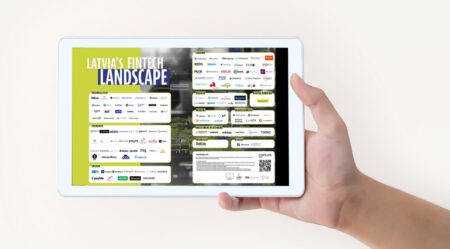
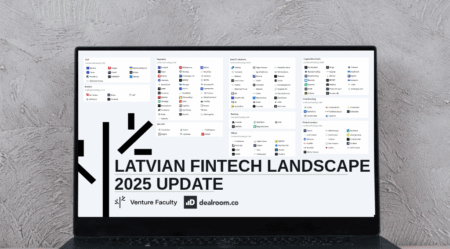
The Startin.LV report also looks at the Latvian fintech industry, sharing data and insights from industry trade group Fintech Latvia Association. According to the organization, Latvia currently hosts 127 fintech companies, including foreign players with local representation.
These companies generated EUR 369 million in turnover in 2024, paid EUR 90 million taxes that year, and are now employing more than 3,600 people. These figures mark increases from previous years, reflecting the sector’s accelerating maturity and growing contribution to Latvia’s economy.
In 2025, the sector witnessed a number of developments. Eight non-bank payment service providers joined the electronic clearing system of Bank of Latvia, and seven new licensed market participants entered the sector, comprising three in crowdfunding, two in payments, and two under the Markets in Crypto-Assets Regulation (MiCA) framework.
More players are expected to enter the market this year as amendments to the Credit Institutions Law enter into force. The new regulatory framework, which took effect on January 06, 2026, creates a brand new category of financial market participant in Latvia, the “specialized credit institution”.
Under this regime, licensed entities can operate as banks while benefiting from initial capital reduced to EUR 1 million, compared with EUR 5 million for a traditional banking license. They can collect deposits, issue loans, offer payment services, leasing, investment and crypto-active services, with the possibility of passporting their activities throughout the European Union (EU).
Latvia is also positioning itself as a leading MiCA gateway in the Baltic region. It was the first EU country to fully implement the MiCA regulation, and according to Invest in Latvia, the national investment promotion agency, more than 100 international companies are reportedly exploring Latvia as their EU base.
Featured image: Edited by Fintech News Baltic, based on image by freepik via Freepik