


The University of Latvia’s BA School of Business and Finance has shifted its focus to financial technologies, digital finance, business process management, sustainable entrepreneurship, and cybersecurity management, aiming to establish itself as an internationally recognized higher educational institution for fintech and with strong practical industry connections.
The school announced its refocus on September 01, 2026, rebranding as the UL Fintech Business School. The academic institution now offers a total of 11 study programs encompassing short-cycle, bachelor’s and master’s levels, with two developed in collaboration with a Swiss business school.
Combining academic knowledge with technological understanding, data literacy, and responsible decision-making, the UL Fintech Business School seeks to form the financial and business leaders of the future, equipping its students with competencies increasingly needed in the financial sector and technology companies, as the boundaries between these fields blur.
The school also plans to strengthen cooperation with financial and technology companies, the public sector, and other employers. This collaboration will involve industry involvement in developing study content, the practical study process, research, and professional development.
The establishment of the UL Fintech Business School is part of the Latvian higher education reform and the integration of the BA School of Business and Finance into the University of Latvia, one of the largest universities in the country. For its inaugural school year, the UL Fintech Business School will see 300 students studying at the school.
Fintech programs proliferate at universities
The revamp of the BA School of Business and Finance into a fintech-focused institution aligns with the growing influence of digital services, artificial intelligence (AI), data analytics, automation and cybersecurity in the financial services industry.
In response to these evolving trends, educational institutions worldwide are proactively adapting their programs.
In Scotland, the University of Edinburgh’s Msc in Finance, Technology and Policy combines financial services, technology, and policy and regulation. The program boasts a strong track record, reporting graduates entering organizations including Deutsche Bank, the European Central Bank, Deloitte, Morningstar and MUFG, among others.
In 2020, the EIT Digital Master School introduced the Master’s in Fintech program. This innovative program is delivered through a network of European universities across France, Italy, Hungary and Spain. Students study at universities in different countries, and receive degrees from two universities. They also engage in an internship or a research-oriented graduation project, providing a comprehensive learning experience.
Latvia’s fintech ambitions
The Latvian fintech industry has grown significantly in recent years. In 2024, the country boasted 127 active fintech companies, employing more than 3,600 people. These companies collectively generated nearly EUR 372 million in combined turnover in 2024 and EUR 97 million in net profit.
That year, companies in the industry paid more than EUR 91 million in taxes, representing a 28% increase from EUR 71 million in 2023. These increases reflect the sector’s accelerating maturity and growing contribution to Latvia’s economy.
The Latvian fintech sector continued its upward trajectory in 2025. Eight non-bank payment service providers joined the electronic clearing system of Bank of Latvia, and seven new licensed market participants entered the sector, comprising three in crowdfunding, two in payments, and two under the Markets in Crypto-Assets Regulation (MiCA) framework.
In August 2026, Latvia had already issued 18 new licenses for the year, underscoring the sector’s continued momentum.
Latvia has set out ambitious goals for its fintech sector centered around strengthening the resilience and competitiveness of its financial industry. Last year, the government issued its Fintech Strategy for the period 2025 to 2027, outlining measures to enhance infrastructure, regulatory clarity, access to capital, and talent development.
During the strategy period, Latvia is targeting a 30% increase in the number of fintech companies operating in the country, a 15% rise in new fintech-related investments, and an 18% growth in fintech-related employment. It also seeks recognition as a competitive fintech centre in the Baltic and Nordic regions.
Latvia is also positioning itself as a leading MiCA gateway in the Baltic region. It was the first country in the European Union to fully implement the legislation. To date, ten entities had been issued a MiCA license from the Bank of Latvia, according to the European Securities and Markets Authority.
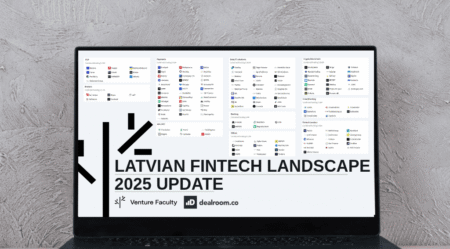
Featured image: Edited by Fintech News Baltic, based on image by smilephotoap via Magnific