



Fintech companies in Lithuania are among the best and fastest adapters to the Covid-19 pandemic. Fintech Hub LT statistics show that Electronic Money Institutions (EMIs) have made the most progress. The latter have demonstrated excellent turnover and profitability figures, which reflect very well the increasing competition for traditional financial service providers.
In 2020, fintech companies operating in Lithuania generated a turnover of EUR 399 million. This is a fifth more than in the pre-pandemic year 2019, when fintech companies generated a turnover of EUR 325 million. This year’s figures are forecast to be much higher.
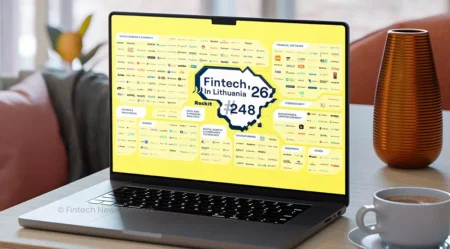
The data sample included e-money institutions (excluding Lithuanian Post and those with limited licences, such as Telia Lietuva, Bitė Lietuva, Tele2 Lietuva, as this is not their core business), payment institutions (excluding those with limited licences), specialised banks, blockchain companies, financial software providers, credit providers, insurtech companies, and crowdfunding operators, totalling 305 firms.
The data were collected from official financial statements and the Centre of Registers, using the services of Okredo.
Fintech Hub LT estimates that the Electronic Money Institutions (EMIs) segment officially became the largest fintech sector in Lithuania in terms of turnover in 2020.
If in 2018 the weight of the EMI segment in the total turnover of fintech companies was only 11.7%, in 2020 EMI companies already generated 26.8% of total turnover, i.e. more than a quarter of the total turnover of fintech companies. Last year, the turnover of EMI companies was EUR 106 million. Compared to 2018, it grew by 3.7 times.
Financial software providers (EUR 102 million turnover in 2020, a 25% share of total fintech turnover) and lending companies (EUR 92.8 million turnover, a 23% share of total fintech turnover) were also among the top three fintech segments in Lithuania.
According to Vaiva Amulė, CEO of Fintech Hub LT association, which unites licenced fintech companies in Lithuania, the leadership of these three segments perfectly reflects the fact that the Covid-19 pandemic has led to a surge in demand for fast, convenient and flexible financial services.

“During the pandemic, the importance of borrowing, finance and money transfer transactions increased, and businesses started to use online trading and alternative financing products more actively. This has been one of the key aspects that has allowed the fintech sector as a whole to grow.
In 2020, the Lithuanian fintech sector generated a net profit of EUR 25.7 million. This is around 8% more than in 2019, i.e. before the Covid-19 pandemic. This year’s figures should be even higher.
Fintech Hub LT’s experts calculate that the biggest increase in net profit between 2018 and 2020 was in the EMI segment, which amounted to EUR 6.4 million.
This means that Lithuanian fintech companies have sufficient financial reserves and capital to invest in the quality and development of their products and services. They also have sufficient capital to invest in increasing the number of employees, risk management, and technology development,”
says V. Amulė.
It is clear that some of the accumulated revenue has been and is being successfully invested in the quality and development of the products or services and in the recruitment of new employees. This is shown by concrete figures.
At the end of 2018, the Lithuanian fintech sector employed 2,812 people, and by 2021, the number of employees increased to almost 5,400. In three years, the number of employees has increased by more than 2,500. The leading areas in terms of recruiting new professionals in the fintech sector were the EMI (800 employees) and software (905 persons) segments.
It is worth mentioning that Fintech companies pay their employees very competitive and high salaries. In 2021, the average salary in the Lithuanian fintech sector was EUR 2,867, 83% higher than the average salary in Lithuania (EUR 1,566). In all fintech segments, average salaries are above the Lithuanian average. EMIs pay the highest average salaries (EUR 4,738).
Some of the dominant investments by fintech companies are related to anti-money laundering (AML) and the development of AML specialists. It is estimated that most fintech companies spend up to a third of their budgets on this area, or up to several million euros per year.
The fintech sector is growing very successfully and showing positive trends not only in Lithuania. International experts expect the overall size of the global fintech market to grow to EUR 191.8 billion by 2025.
The annual growth rate (CAGR) will reach 10.2%. The main factors driving the growth of this market are the increasing demand for smartphones and banking apps, rising investment in fintech companies by private investors, faster internet penetration, and the wider use of artificial intelligence (AI) and blockchain technologies.
Featured image credit:Technology photo created by freepik – www.freepik.com